Integrate any source
Static and non-static data from files, databases, APIs, enterprise systems, industrial platforms, machines, sensors and IoT.
Technology Consulting & Systems Integration
A new intelligence layer for your enterprise.
sBRO develops and integrates Enterprise Intelligence Systems that unify heterogeneous data, translate it into a common enterprise representation and create the process knowledge foundation for advanced analytics, AI and industrial use cases.
What sBRO is
sBRO works where industrial operations, enterprise systems, advanced engineering and research meet. We integrate complex technology environments and provide the consulting expertise required to turn integrated data into deployable industrial value.
Our role is not to replace the systems that already run your business. It is to connect them, give their data a common meaning and make that knowledge usable across the enterprise.
Our main product
We position the EIS as the enterprise's highest layer of data integration and process knowledge: a common intelligence foundation that spans the systems already operating across the company.
ERP, WMS/TMS, MES, SCADA, control systems, field devices, databases, APIs, files and IoT platforms each contain part of the operational picture. EIS integrates across those layers.
The result is a unified and contextualized representation of the enterprise that can support multiple departments, digital twins and future use cases without rebuilding the integration logic for every new project.
Illustrative view: EIS spans the existing technology landscape and creates a common enterprise-level representation.
How EIS works
Static and non-static data from files, databases, APIs, enterprise systems, industrial platforms, machines, sensors and IoT.
Convert heterogeneous inputs into a single streaming-oriented representation so information can be handled consistently.
Clean, validate, normalize and standardize structures, timestamps, keys and values.
Group information according to the company scope, process or organizational domain it represents.
Translate the normalized information into a proprietary high-level abstract language developed by sBRO experts.
Assign the resulting information to one or more relevant digital twins, creating reusable process and system context.
The outcome
Once EIS is in place, new analytics, AI, optimization, decision-support, simulation and process-improvement use cases can build on the same integrated and contextualized data foundation.
Our innovation model
sBRO deliberately separates reusable technology development from client-specific deployment. This is fundamentally different from treating every industrial use case as a new linear TRL 0-to-10 project.
Agnostic, robust and smart components are researched, specified, prototyped, digitally de-risked and validated. They are then integrated into the Enterprise Intelligence System, whose architecture, interoperability and performance are developed and tested before client-specific use cases are built.
After acquiring the EIS, the client can commission use-case work from sBRO, another technology consulting or systems integration company, or universities and ENESIIs. Stage 3 covers on-site integration, client data transformation, use-case configuration, algorithm and human-in-the-loop work, adaptation, acceptance testing and sustained deployment.
sBRO hybrid R&D & engineering approach
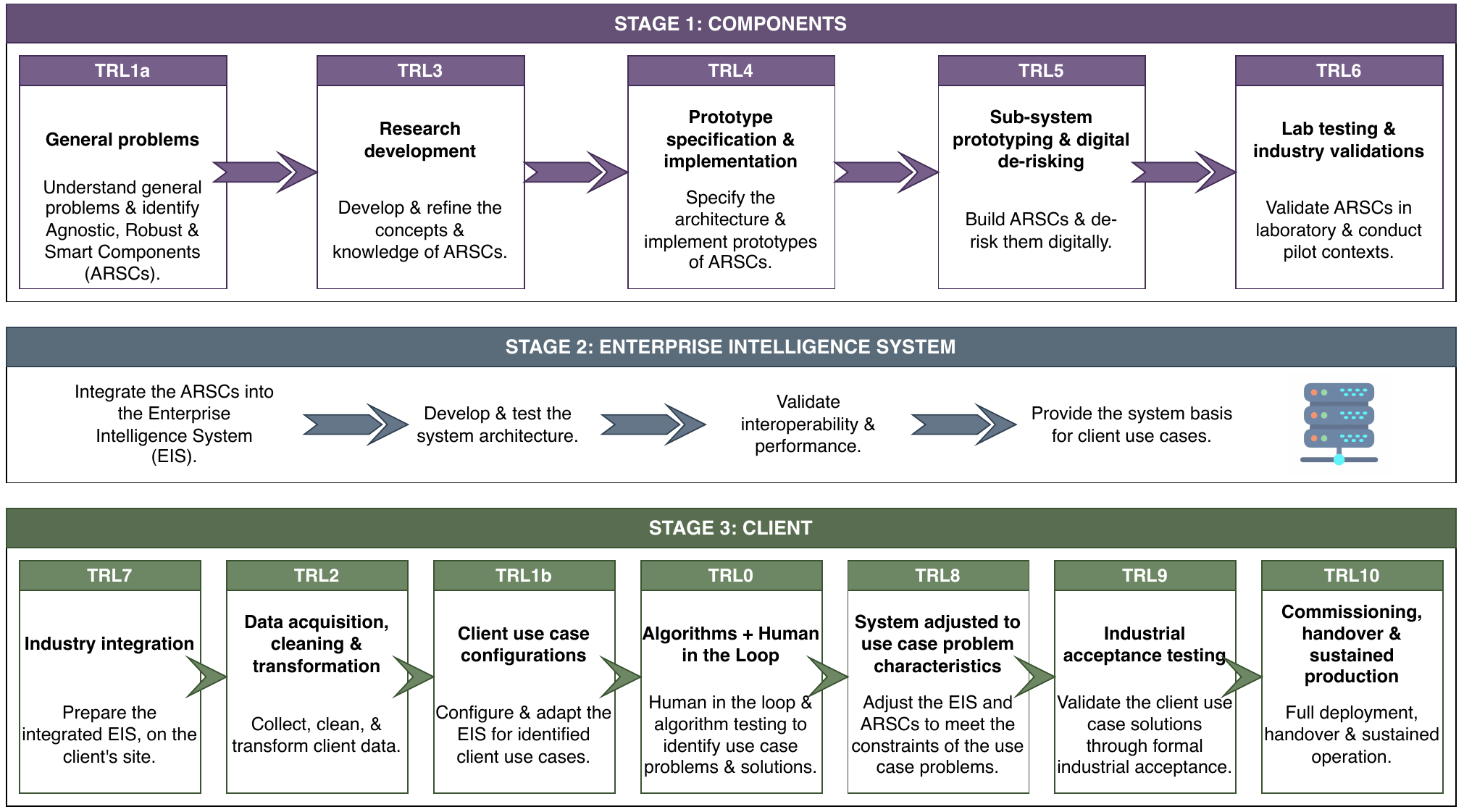
Stage 1 develops and validates reusable components. Stage 2 integrates them into the EIS. Stage 3 applies that mature foundation to the client's environment and use cases.
Why this is different
Traditional R&D projects typically mature one client problem progressively from early research to deployment. sBRO separates the maturation of reusable technology from the configuration of each client solution. The TRL labels still describe the nature of the work, but they are not used as a single linear sequence for every new use case.
Research, architecture, integration and validation are repeatedly developed around each specific client problem.
Reusable intelligence components and the EIS are matured as a product foundation; client-specific engineering builds on top of that foundation.
Consulting & systems integration
sBRO can deliver Stage 3 services directly or collaborate with the client's preferred technology partners, systems integrators, universities and research institutions.
On-site integration, connectivity, deployment architecture and interoperability across enterprise and operational systems.
Translate business and operational challenges into technically feasible configurations, workflows and intelligent applications.
Develop predictive, diagnostic, prescriptive and decision-support capabilities on top of the EIS foundation.
Adapt solutions to site characteristics, test against operational requirements and support acceptance and sustained use.
Connect complex industrial challenges with leading experts, universities and ENESIIs when new knowledge or technology is required.
Enable third-party technology consultants and integrators to develop client use cases on a common, structured enterprise intelligence base.
An open innovation ecosystem
Industries we serve
Our experience is concentrated in environments where enterprise information, physical systems and operational decisions must work together.
Production systems, quality, bottlenecks, maintenance, resource efficiency and human-machine environments.
Warehouses, ports, terminals, distribution, freight, transport networks, last-mile operations, fleet and asset utilization.
Why sBRO
A product foundation and consulting model designed for organizations that need more than isolated point solutions.
Connect enterprise, operational, control and field information without replacing the systems already in place.
Build new use cases on a common semantic and digital-twin foundation instead of reintegrating data from scratch.
Leadership experience recognized nationally and internationally across AI, machine learning, continuous improvement and engineering.
Start with the integration problem
Talk to sBRO about your current systems, data sources and operational priorities. We can assess where EIS fits and what consulting or integration work is required next.